
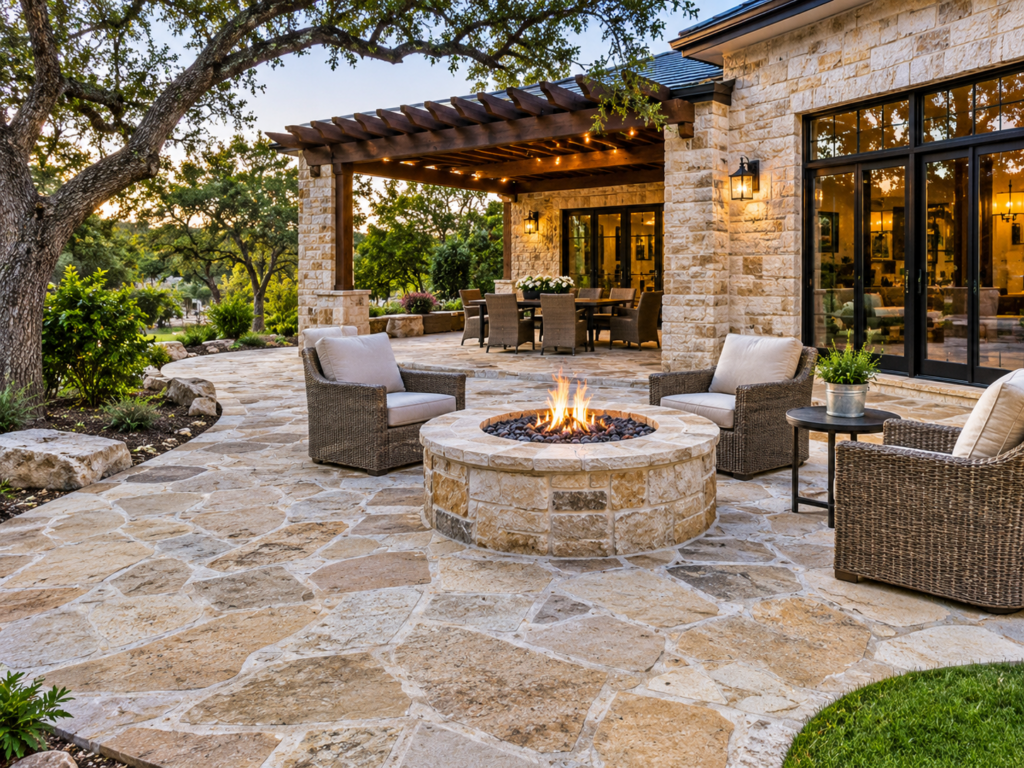
If you’ve ever stepped out on a beautifully laid stone patio and just stood there for a moment soaking it all in, you already know something important. Good stonework is not only good for function. It gives you a feeling. It gives a backyard a sense of permanence, quality and intention that no other material quite manages to replicate. That’s the whole point of investing in rock patios done right and in Austin, where outdoor living is practically a way of life, getting that investment right is more important than most people realize.
The truth is, not all outdoor surfaces are created equal. Many homeowners learn this the hard way after a few years of living with cracked concrete, faded stamped surfaces or paver systems that shift and sink after the first heavy rainy season. That’s not how natural stone acts when installed correctly. It stands its ground. It retains its character. And honestly, it tends to look better as it gets older rather than worse.
Why Investing in Rock Patios is a Good Idea
There are a few reasons why you should choose natural stone over other paving materials and these reasons really do count in the long term. Durability is the most obvious. Natural stone is not a manufactured product with an expected lifespan printed on the box. It is a material that has been sitting in the ground for millions of years and has already shown what it can do. Heat, cold, moisture or heavy foot traffic are not particularly threatening to well laid stone.
But durability is not everything. There is also a visual quality aspect. Concrete and composite materials may look like stone but there is a flatness to imitation surfaces which is difficult to ignore once you’ve seen the real thing next to it. Natural stone has depth, variation and a texture that reflects light differently at different times of day. In the late afternoon sun a limestone patio looks alive in a way stamped concrete just can’t match.
Austin homeowners who’ve had A and J Masonry construct rock patios have consistently said the finished product made their entire property feel elevated, not just the backyard. It’s hard to put a number on that kind of impact but it’s real.
Choosing the right stone for Austin’s climate and style
Not all stone types perform the same in all environments and Central Texas has particular conditions that should guide material choices. During the summer months the heat is intense. Rain events can be heavy and abrupt. Many areas of Austin have soils of expansive clay that shift with changes in moisture and can stress any surface not properly anchored.
There are a number of reasons why this area is a natural fit for limestone. Locally it is a familiar one, comes in a variety of finishes and cuts, handles the temperature swings of a Texas climate well. It looks great with the architectural mix in Austin too, natural on a modern hill country home as it is on a more traditional estate property. Depending on the design direction, limestone can be cut into clean geometric pieces for a formal layout or left with natural edges for a more organic, casual feel.
Stone pavers offer more design options. Individual pavers can be laid out in various patterns to create very different visual effects from the same material. A running bond pattern is more casual and relaxed. There is structure and a little energy to a herringbone layout. A random mix of sizes gives a space that natural, collected-over-time quality that tends to suit outdoor living areas particularly well. The right pattern is part of the design conversation that a skilled masonry team will have with you before any stone hits the ground.
The Build Process – What’s Involved In A Proper Patio?
One thing that separates a long-lasting patio from one that starts showing problems in a few short years is what happens before the first stone is ever laid. This is where most shortcuts are taken in the preparation work. It is also where most failures start.
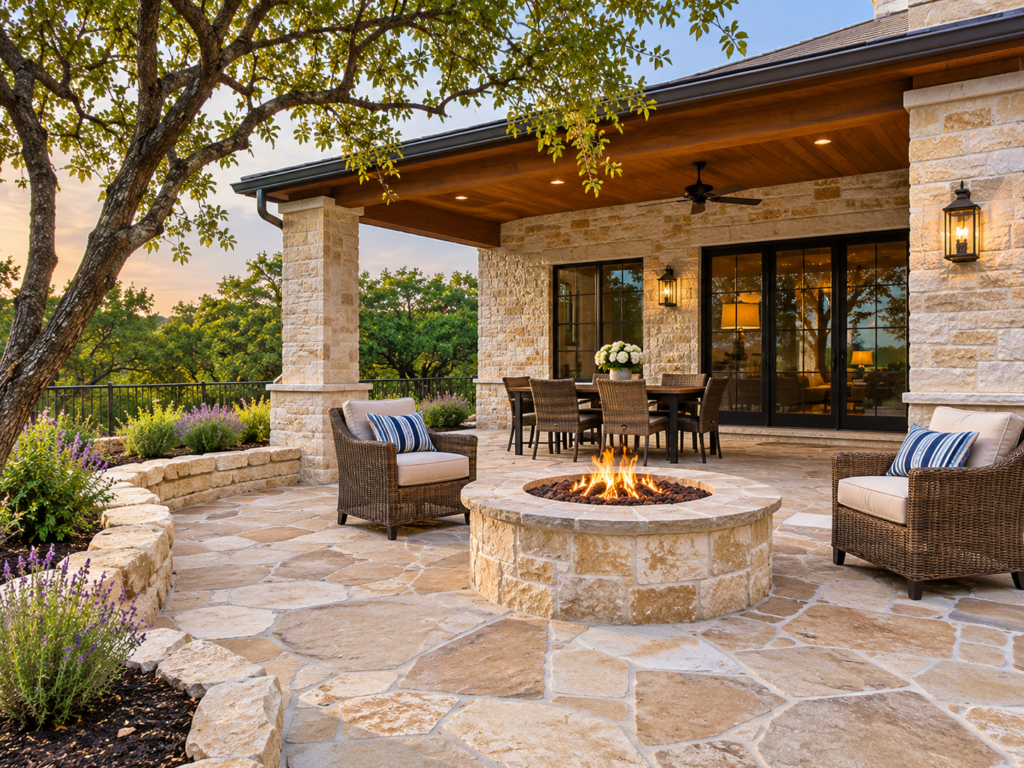
The first step to building a good natural stone patio is to do a complete site analysis. Knowing how water moves through the space, what the conditions are in the soil below, and how the patio connects to the grade of the surrounding landscape inform the decisions that follow. Then proper excavation and compaction of the sub-base material and laying of the bedding layer so that the stone has a stable, consistent foundation to sit on.
Here’s a quick breakdown of what that whole process looks like:
- Reviewing the site and assessing drainage, slope, soil type and how the patio relates to surrounding features.
- Excavation and sub-base prep: Taking out the right amount of material and compacting a solid, stable base.
- Material selection and layout planning: Selecting the type, size, and color of stone and the pattern that suits the design.
- Stone cutting and fitting: Cutting individual pieces to fit the space’s particular dimensions and curves.
- Setting and leveling: The stones are set precisely, joints kept even, the stones sloped for drainage.
- Finishing and cleanup: Final checks on stability, joint filling and site cleanup after the patio has been finished.
Each of these steps has to be attended to. Skipping or rushing any of them creates a problem that comes up later on. This is a process the A and J Masonry team follows on every project because the standard doesn’t vary with the size of the job.
How a Patio Fits In With the Rest of the Outdoor Space
The most satisfying outdoor living environments are the ones where everything feels like it belongs together. A gorgeous patio surface butting up to a mismatched retaining wall or disjointed series of steps doesn’t tell a cohesive story. The design and the build have to work across all of the elements at the same time.
This is the way A and J Masonry does outdoor projects. Rock patios are typically just one component of a larger outdoor living environment that may also include stone retaining walls, custom steps, seating walls, fire pits, outdoor kitchens and decorative stonework accents. If all of these features are designed and built by the same skilled team, using materials that work together visually, then it feels like an intentional and complete whole, rather than something that has been pieced together over time.
Their portfolio includes some of the most exclusive properties in Austin in West Austin, Bee Cave, Travis Heights and the 360 Bridge area. Go through that body of work, and the consistency of the craftsmanship, the visual cohesion of the finished spaces, tells you a lot about how the team thinks about projects.
The Long Term Usefulness of Stone Pavers
It is worth mentioning the practical side of the choice of individual stone pavers, not a solid slab surface. If ever it needs to be accessed, whatever is under pavers can be. Individual pavers can be lifted and reset to get to underground utility lines, drainage components or irrigation systems without disturbing the rest of the surface. “That flexibility is really valuable for a property that can change over time.”
Pavers are also easier to patch in isolated areas. If roots or soil movement affect one section of a paver patio, you can fix that section without removing the entire surface. A solid slab of stone doesn’t quite have that option. Both have their advantages, and the choice is determined by the particular project and site conditions and the homeowner’s long-term plans for the area.
What Sets Skilled Masonry on These Projects Apart
Those who have worked with A and J Masonry on patio projects describe a process that doesn’t feel like working with a typical contractor. The team is prepared. They communicate on the job. They deal with problems as they arise, no drama. And they finish what they start to a standard equal to or better than what was talked about at the start.
Reliability like that isn’t a given in the trades, and luxury homeowners in particular feel its absence acutely when it’s missing. It is a credit to a team that really knows their stuff, and cares about the end result, when a project such as a custom stone patio goes well from the first site visit to the final clean up.
Conclusion:
One of the most truly rewarding outdoor investments a property owner can make is rock patios and stone pavers. The materials are beautiful, the results are long-lasting, and when done by a team with real masonry skill and experience, the finished product adds lasting value to the property in ways other surface materials just cannot match. In Austin, outdoor spaces are used hard and expected to look great year-round, so choosing the right masonry team for this type of project is no small decision. It is the one that decides if your patio is something you enjoy for the next thirty years or something you have to redo.
5 Frequently Asked Questions
1. What is the main benefit of choosing rock patios over concrete?
Natural stone offers far greater durability, a richer visual quality, and a surface that ages beautifully rather than fading or cracking the way concrete alternatives often do over time.
2. How are stone pavers different from a solid stone patio surface?
Stone pavers are individual pieces laid in a pattern, which allows for more design flexibility, easier repairs in specific areas, and access to utilities beneath the surface if ever needed.
3. How does Austin’s climate affect material selection for patios?
The heat, heavy rain cycles, and expansive clay soil in Central Texas all influence which stone types and base preparation methods perform best. An experienced local masonry team will guide this selection properly.
4. Can a stone patio be integrated with other outdoor features like kitchens or fire pits?
Absolutely. In fact, the best results come from designing and building the patio as part of a cohesive outdoor living environment that includes retaining walls, steps, seating areas, and other features together.
5. What neighborhoods in Austin does A and J Masonry serve for patio projects?
They serve West Austin, Bee Cave, Travis Heights, the 360 Bridge corridor, and surrounding high-end communities throughout the greater Austin area.